Governor’s Rule in KP: Legal Experts Explain the Federal Government’s Constitutional Powers
Published: October 11, 2026 | Politics & Constitution
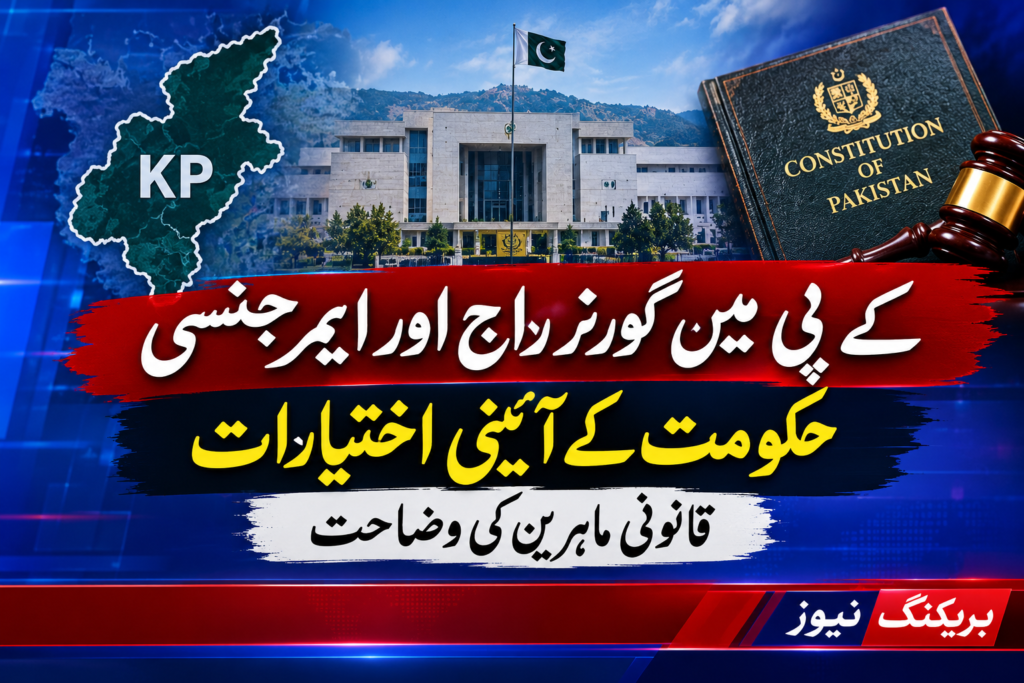
On Sunday, the federal government imposed governor’s rule in KP (Khyber Pakhtunkhwa) and declared an emergency. As a result, the province’s governance arrangements have changed. President Asif Ali Zardari approved the measures under Articles 232(1) and 234(1) of the Constitution, and they took effect immediately. Reports say the emergency covers 12 districts.
Key Points
- Article 232 covers emergencies, while Article 234 covers the failure of constitutional machinery in a province.
- Governor’s rule lasts two months unless a joint sitting of Parliament approves it.
- In total, governor’s rule cannot exceed six months.
- Supporters cite security failures, but critics raise concerns about provincial autonomy.
The decision has sparked a national debate. People are arguing about the federal government’s constitutional powers, the chief minister’s authority and the legal requirements for emergency rule.
The move comes amid growing concern over terrorism. Moreover, some allege that the provincial government failed to protect citizens. Supporters say extraordinary action is necessary to improve security. Critics, however, question its effect on provincial autonomy and democratic governance. Legal experts point to Articles 232 and 234 as the key provisions. Both allow significant federal intervention, but they carry different legal requirements.
Supporters: A Constitutional Remedy for a Serious Situation
Supreme Court lawyer Haris Azmat described the decision as constitutional. He argues that the Constitution provides mechanisms for situations that demand extraordinary intervention. In his view, Articles 232 and 234 exist for exactly such circumstances. Therefore, he says, the deteriorating security situation in KP justifies decisive measures.
However, the validity of the action depends on whether the government has met the conditions in these provisions. Security concerns alone do not remove the need to follow the legal process.
The Counterterrorism Argument
Supporters also argue that the provincial government did not act in time against militant violence. They say the administration should have responded more effectively and strengthened protection in vulnerable districts. In their view, federal involvement will improve coordination between security institutions. It will also bring immediate attention to public safety.
Still, these remain allegations, not established legal findings. To assess them, one needs the provincial government’s response, the available security records and the full circumstances behind the decision. Ultimately, the measures will succeed only if they measurably improve security for people in the affected areas.
What Happens to the Chief Minister’s Powers?
Governor’s rule has raised questions about the authority of KP Chief Minister Sohail Afridi. It has also raised questions about the future role of the provincial government. Lawyer Hasan Raza Pasha argued that the provincial government cannot decide the validity of the federal intervention itself. Instead, he said, the constitutional framework must answer such questions.
Under Article 234, the president may issue a proclamation when he is satisfied that a provincial government cannot function in accordance with the Constitution. Reports say the proclamation refers to a report from the KP governor. According to the official announcement, the governor will exercise the powers of provincial institutions and officials. The exception is the provincial assembly, whose powers Parliament, or a body acting under its authority, will exercise.
Depending on the proclamation’s wording, the chief minister and cabinet may lose authority over the transferred functions. In fact, some reports say they no longer hold office. However, the precise legal consequences depend on the official proclamation and the powers it covers.
An emergency under Article 232 works differently. It can also allow the federal government to assume specified provincial functions. Even so, it does not automatically stop every provincial institution from working.
Article 232: Emergency Powers Explained
Article 232 sets out how the president can declare an emergency. This applies when war, external aggression or an internal disturbance threatens the security of Pakistan, or any part of it. The disturbance must be beyond the provincial government’s power to control.
During an emergency:
- Parliament may legislate on provincial subjects within the constitutional framework.
- The federal government may direct how the province exercises its executive authority.
- The federal government may assume certain provincial functions through the relevant mechanism.
However, these powers are not unlimited. The government must follow the procedures and parliamentary approval requirements in the Constitution. Because the article refers to “any part of the country,” it applies to an emergency limited to specific districts. Still, the official notification must confirm the geographical scope and legal basis.
Article 234: How Governor’s Rule in KP Works
Article 234 addresses the failure of constitutional machinery in a province. It applies when the president receives a report from the governor and concludes that the provincial government cannot function in accordance with the Constitution.
The president may assume certain provincial functions, or direct the governor to exercise them. The president may also provide that Parliament, or a body it authorises, will exercise the assembly’s powers. Importantly, neither the president nor the governor can assume the powers of the high court or suspend its operations.
The president must place the proclamation before a joint sitting of Parliament. Governor’s rule runs for an initial two months. The joint sitting can extend it by up to two months at a time. In total, it cannot exceed six months.
Therefore, governor’s rule is an exceptional constitutional arrangement, not an ordinary administrative decision. Its legality depends on whether the government has satisfied the conditions of Article 234.
Can the Federal Government Declare an Emergency in Only 12 Districts?
Article 232 allows an emergency to address a qualifying threat in a particular part of the country. However, a geographically limited emergency does not by itself justify taking over the provincial government across the whole province.
Article 234 asks a different question. It asks whether the provincial government can continue to function in accordance with the Constitution. For this reason, constitutional experts stress that courts and commentators should examine the justification for governor’s rule separately from the justification for the emergency. The official proclamation, its stated grounds and the powers it transfers are essential to that assessment.
Can Governor’s Rule Be Challenged in Court?
Article 236 contains provisions on the validity of proclamations and orders under the emergency provisions. These provisions complicate judicial review. In practice, the constitutional text and judicial interpretation determine whether courts can scrutinise a proclamation and how far they can go.
Nevertheless, it would be inaccurate to assume that every proclamation is automatically immune from judicial scrutiny. Equally, not every challenge will succeed. Any petition would need to address the constitutional provisions, the circumstances the federal government cites, the procedure it followed and the relevant case law.
What It Means for KP’s Political Future
The decision could have significant implications for provincial autonomy, political stability and federal-provincial relations.
Supporters argue that stronger federal coordination will help tackle terrorism and strengthen law enforcement. Critics, on the other hand, warn that removing powers from an elected provincial government could deepen political tensions. They also argue that extraordinary measures must not replace political dialogue and accountable governance.
The outcome will depend on how the authorities implement the measures and how far federal officials use their powers. It will also depend on how constitutional oversight operates. In addition, lasting security will require sustained counterterrorism planning, effective policing and intelligence coordination. Cooperation between federal and provincial institutions will matter as well.
Frequently Asked Questions (FAQs)
How many years of martial law has Pakistan had?
Martial law was formally imposed three times:
- 1958 to 1962: General Ayub Khan
- 1969 to 1971: General Yahya Khan
- 1977 to 1985: General Zia-ul-Haq
Together, these periods add up to roughly 14 years of formal martial law. General Pervez Musharraf took power in 1999 under a proclamation of emergency, not martial law. However, if you count all periods of military-led government, the total is commonly put at over 30 years.
What are the legal rights of a wife in Pakistan?
A wife in Pakistan generally has the following rights:
- Dower (haq mehr): She has a legal right to the agreed amount or property in the nikahnama.
- Maintenance: Her husband must provide for her, and she can claim maintenance through a Family Court.
- Dissolution of marriage: She may seek dissolution under the Dissolution of Muslim Marriages Act, 1939, or ask for khula.
- Inheritance: She receives a defined share in the estates of her husband and parents under Islamic law.
- Protection from violence: Provincial laws give her remedies against domestic violence and harassment.
Rules vary by province and religion. Therefore, anyone with a specific case should consult a qualified family lawyer.
What does Article 143 of the 1973 Constitution of Pakistan say?
Article 143 deals with inconsistency between federal and provincial laws. If a provincial law conflicts with a federal law that Parliament can enact, the federal law prevails. As a result, the provincial law is void to the extent of the conflict.
How are ordinances passed in Pakistan?
Parliament does not pass ordinances. Instead, under Article 89, the President promulgates an ordinance on the Prime Minister’s advice. He can do so when the National Assembly is not in session and immediate action is needed.
- An ordinance has the same force as an Act of Parliament.
- The President must lay it before the National Assembly.
- It lapses after 120 days, or earlier if the National Assembly disapproves it by resolution.
- The National Assembly can extend it once for a further 120 days.
Similarly, provincial governors can issue ordinances under Article 128, with their own time limits.
Conclusion
Governor’s rule in KP and the accompanying emergency have put the federal government’s constitutional powers at the centre of a major national debate. Article 232 provides the framework for emergency action. Article 234, on the other hand, deals with the failure of constitutional machinery in a province. Each serves a different purpose and carries distinct legal requirements.
Therefore, readers should judge claims that the provincial government’s and chief minister’s powers have ended against the official proclamation and the functions it transfers. Likewise, they should weigh allegations of security failure against the evidence. In the end, the intervention’s legitimacy and success will rest on constitutional compliance, effective security measures and democratic accountability.